Crypto Exchange Volume Slumps To $1.6T In November
Crypto exchange volume drops to $1.6 trillion in November, hitting its lowest level since June. Discover what’s driving the slowdown and what it means for traders.

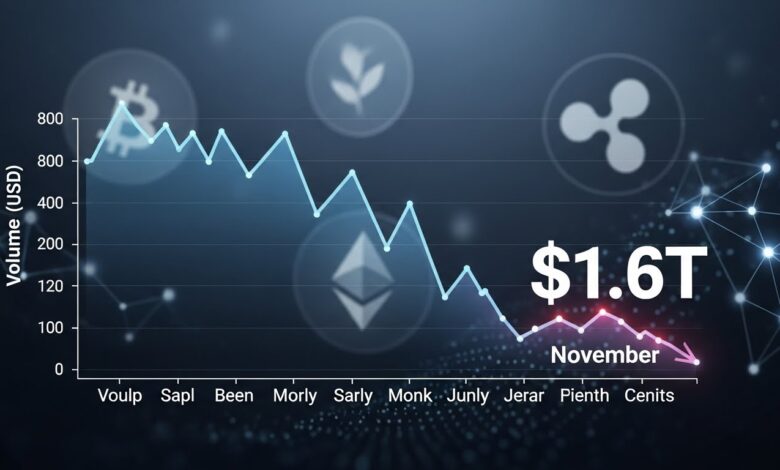
Crypto markets move in cycles, and trading activity is often the clearest signal of where we are in that cycle. When crypto exchange volume drops to $1.6 trillion in November, lowest since June, it raises an important question for traders, investors, and analysts alike: is this just a temporary cooldown or an early sign of a deeper shift in market sentiment?
Trading volume is one of the most watched indicators in digital asset markets. It reflects how actively participants are buying and selling cryptocurrencies on centralized and decentralized platforms. When volume rises, it usually signals strong interest, momentum, and liquidity. When volume falls, it can point to uncertainty, risk-off behavior, or simple exhaustion after a busy period.
In November, crypto exchange volume slipped to around $1.6 trillion, marking its weakest level since June. This decline came after months of relatively strong activity, driven by narratives such as institutional adoption, regulatory developments, and Bitcoin’s role as a macro asset. The sudden slowdown has prompted many market participants to reassess their strategies, risk exposure, and expectations for the months ahead.
In this article, we will break down what this drop in trading volume really means. We will explore how centralized and decentralized exchanges are affected, why volumes are falling, what it signals about market sentiment, and how traders can adapt. By understanding the context behind the numbers, you can make more informed decisions rather than reacting blindly to headline figures.
Crypto Exchange Volume
What Is Crypto Exchange Volume?
At its core, crypto exchange volume represents the total value of all cryptocurrency trades executed on exchanges within a specific period, usually measured daily or monthly. When you see that crypto exchange volume drops to $1.6 trillion in November, you are looking at the combined trading activity across major platforms over that month.
This figure includes trades on centralized exchanges (CEXs) like Binance, Coinbase, and OKX, as well as decentralized exchanges (DEXs) such as Uniswap, Curve, and PancakeSwap, depending on the data provider. Volume can be measured in USD terms or in crypto units, but USD value is more commonly used because it provides a clearer picture of capital rotation.
Why Volume Matters More Than Price Alone
Price often gets the most attention, but volume tells you how meaningful that price movement is. A sharp price move on low volume can be misleading, while a similar move on high volume suggests broad participation and conviction.
When crypto exchange volume drops, several important things can happen. Liquidity may thin out, bid-ask spreads can widen, and it becomes easier for large trades to move the market. This can increase volatility in the short term, even if overall activity is lower. At the same time, weakening volume can signal that fewer participants are willing to take risk at current price levels, hinting at a potential shift in trend or a consolidation phase.
For analysts and professional traders, trading volume is a key part of technical and on-chain analysis. It helps confirm breakouts, identify distribution or accumulation phases, and assess whether a rally or sell-off is sustainable. That is why a drop to $1.6 trillion in November, the lowest since June, is worth paying close attention to rather than treating it as just another data point.
The November Slowdown: From June To Now
How November Compares To Previous Months
When we say crypto exchange volume drops to $1.6 trillion in November, lowest since June, we are describing a clear step down in activity compared to recent months. Earlier in the year, strong narratives around halving cycles, regulatory clarity in some regions, and growing institutional interest in Bitcoin and altcoins fueled higher volumes.
June marked the previous low point for trading volumes, often associated with seasonal patterns, macroeconomic uncertainty, or a pause after strong rallies or sell-offs. From July through October, many exchanges saw a modest rebound in volume as volatility picked up and traders responded to headlines around monetary policy, exchange-traded products, and new token launches.
However, as November unfolded, this momentum began to cool. Daily volumes trended lower, and the aggregate figure for the month settled near $1.6 trillion, undercutting several prior months and revisiting levels not seen since the quieter mid-year period.
Seasonal Effects And Market Cycles
Crypto markets, despite their 24/7 nature, are not immune to seasonal trends. Historically, the final quarter of the year can be mixed. Some years see explosive rallies, while others experience consolidation as traders lock in profits or step back ahead of the new year.
The fact that crypto exchange volume fell to $1.6 trillion in November suggests that, in this cycle, traders were more cautious. This could be due to uncertainty around macroeconomic conditions, regulatory announcements, or the exhaustion of earlier speculative rallies. When price volatility compresses or trends stall, many short-term traders simply lose interest, resulting in lower spot and derivatives volumes.
At the same time, more experienced investors may deliberately scale back trading in lower-liquidity conditions to avoid unnecessary slippage. This self-reinforcing behavior can further reduce volume until a new catalyst emerges to reignite participation.
Centralized Vs Decentralized Exchanges
Impact On Centralized Exchanges

Centralized exchanges remain the primary venue for crypto trading volume. When crypto exchange volume drops to $1.6 trillion in November, a large portion of that decline is usually driven by reduced activity on major centralized platforms.
For centralized exchanges, lower volume can have several direct implications. Trading fees are typically their main revenue source, so a decline in volume may translate into lower fee income. This can impact their profitability, marketing budgets, and incentive programs such as fee discounts and reward campaigns.
From a market structure perspective, lower volume on centralized exchanges can also affect order book depth. With fewer active traders, liquidity providers may reduce their exposure, leading to wider spreads and more abrupt price moves when large orders hit the market. Retail traders may notice that their market orders have more impact on price, while institutional players may temporarily switch to over-the-counter (OTC) desks for larger trades.
Despite these challenges, large centralized exchanges often use quiet periods to build new products, expand into new jurisdictions, or strengthen compliance frameworks. Historically, periods of muted crypto exchange volume have coincided with behind-the-scenes infrastructure improvements that set the stage for the next wave of adoption.
Impact On Decentralized Exchanges
Decentralized exchanges, powered by smart contracts and automated market makers, are equally affected when overall cryptocurrency trading volume declines. DEX activity is closely linked to on-chain fees, yield opportunities, and the appeal of decentralized finance (DeFi) protocols.
When crypto exchange volume drops, DEXs often see lower liquidity provider earnings because trading fees are a key component of their rewards. This can lead some providers to withdraw liquidity, further reducing depth and making trades more expensive due to higher slippage. In response, protocols may increase token incentives or governance rewards to keep capital within their ecosystems.
On the user side, lower activity can slow down the pace of innovation-driven speculation. New token launches, DeFi strategies, and yield farming campaigns may attract less capital in a low-volume environment. However, long-term DeFi users often view these quieter periods as opportunities to reposition carefully without the noise and hype that dominate more speculative phases.
Importantly, because decentralized exchanges operate on transparent blockchains, analysts can closely monitor how the drop in crypto trading volume is distributed across chains and protocols. This helps identify which ecosystems remain resilient and which are losing traction.
Key Drivers Behind The Volume Decline
Reduced Volatility And Fewer Catalysts
One of the primary reasons crypto exchange volume drops to $1.6 trillion in November is the simple fact that volatility cooled down. When prices move within narrow ranges and no major catalysts are driving sentiment, both retail and professional traders tend to reduce position sizes or stay on the sidelines altogether.
In earlier months, events such as macroeconomic data releases, regulatory announcements, or institutional product launches sparked sharp moves in Bitcoin, Ethereum, and major altcoins. These events naturally drew in more traders, boosted derivatives activity, and increased spot trading volumes. By November, many of these themes had played out or entered a wait-and-see phase, leaving the market short of fresh narratives.
A low-volatility environment often leads algorithmic and high-frequency trading strategies to scale back as well, since their models may become less profitable when price action is subdued. This compounds the drop in volume and reinforces the perception that the market is “quiet.”
Regulatory And Macro Uncertainty
Regulation and macroeconomic policy remain critical external factors for crypto markets. Even if there are no new major crackdowns or bans, ongoing uncertainty can weigh on trader confidence. When participants are unsure about how new rules on stablecoins, exchanges, or taxation will evolve, they may choose to reduce activity rather than take on additional risk.
Similarly, global macro trends such as interest rate expectations, inflation data, and risk appetite across equities and bonds can strongly influence crypto trading volume. If investors perceive that traditional markets offer safer or more attractive risk-adjusted returns, they might temporarily allocate less capital to volatile digital assets.
November’s decline in volume, reaching the lowest since June, reflects this combination of regulatory noise and macro caution. While crypto remains a long-term theme for many institutions, short-term positioning can soften during periods where the broader financial system is digesting new information or awaiting key policy decisions.
Shift In Trader Behavior
Another subtle but important driver of lower volumes is the gradual shift in trader behavior. During highly speculative phases, many participants chase short-term gains, rotate aggressively between altcoins, and employ leverage through derivatives. This naturally inflates crypto exchange volume.
As markets mature, a growing portion of participants adopt longer-term strategies such as dollar-cost averaging, staking, or simply holding blue-chip assets like Bitcoin and Ethereum in cold storage. These approaches generate less frequent trading activity, which can reduce aggregate volume even if total capital invested in the space is growing.
In November, after various periods of heightened volatility earlier in the year, some traders may have decided to lock in profits, unwind leveraged positions, or reposition into stablecoins. This type of de-risking behavior often results in a quieter market, where fewer participants are willing to chase short-term moves, contributing to the observed drop to $1.6 trillion in volume.
What The Drop Means For Market Sentiment
Is Low Volume Bullish Or Bearish?
When crypto exchange volume drops to $1.6 trillion in November, lowest since June, many observers instinctively interpret it as bearish. However, the relationship between volume and price is more nuanced.
Low volume can be bearish if it occurs during a downtrend, as it may indicate a lack of buying interest and the exhaustion of positive catalysts. In such scenarios, any negative news can trigger outsized moves because there are fewer active buyers to absorb sell orders.
On the other hand, low volume can also be a sign of consolidation after a strong rally, where both buyers and sellers pause to reassess. In this case, subdued cryptocurrency trading volume might simply reflect a temporary equilibrium. Once a new catalyst appears, volume can surge again as participants re-engage with the market.
To understand whether November’s drop is bullish or bearish, traders must look beyond the volume figure and consider price action, funding rates, on-chain data, and macro conditions. Volume is a crucial puzzle piece, but it does not tell the whole story on its own.
Sentiment Among Retail And Institutional Traders
Retail sentiment tends to be highly sensitive to price movements and headlines. When trading activity slows and prices move sideways, many casual participants lose interest, open their trading apps less frequently, and wait for the next big move. This can create the impression that the market is “dead,” even though long-term builders and investors remain active.
Institutional sentiment is generally more disciplined and strategic. A drop in crypto exchange volume may lead some institutions to reduce short-term trading activity, but many continue to refine infrastructure, custody solutions, research, and risk management frameworks. For them, quieter markets can provide breathing room to prepare for future cycles.
The November decline to $1.6 trillion suggests a cautious but not necessarily pessimistic environment. Many participants are watching closely for signals of renewed momentum, such as stronger inflows to spot products, rising open interest in derivatives, or increasing on-chain activity in DeFi and Web3 applications.
How Traders And Investors Can Respond
Adapting Strategies In A Low-Volume Environment
When crypto exchange volume drops, traders need to adjust their expectations and risk management practices. In thinner markets, it is especially important to pay attention to order size, slippage, and liquidity across different trading pairs.
Short-term traders may want to focus on higher-quality pairs with deeper liquidity, such as BTC and ETH against major stablecoins. They can also adapt by using limit orders instead of market orders to control entry and exit prices. Strategies that depend heavily on high volatility, such as aggressive scalping or certain arbitrage setups, might need to be scaled back.
For swing traders and position traders, low-volume periods can be an opportunity to study technical setups more patiently, identify key support and resistance zones, and wait for clear confirmations before entering trades. Instead of chasing every small move, they can prioritize capital preservation and avoid overtrading.
Long-Term Opportunities Behind The Numbers
From a long-term investment perspective, the fact that crypto exchange volume drops to $1.6 trillion in November, lowest since June does not necessarily undermine the broader adoption story. Historically, many successful investors in digital assets have taken advantage of quieter periods to accumulate high-conviction assets, perform deeper research, and diversify across sectors such as DeFi, infrastructure, and Web3.
Lower volume and reduced hype can also mean fewer distractions and less fear of missing out. This creates a healthier environment for studying fundamentals, examining roadmaps, and evaluating the resilience of different protocols.
Investors who view crypto as a multi-year theme may see low-volume months as natural phases in a still-developing market. As long as the underlying technology, network usage, and institutional interest continue to evolve, short-term fluctuations in trading volume become part of the normal noise of a maturing asset class.
The Road Ahead For Crypto Exchange Volume
As markets move beyond November’s slowdown, several factors could influence whether crypto exchange volume remains subdued or rebounds. New regulatory clarity, major technological upgrades like protocol forks or scaling solutions, and macroeconomic shifts can all act as powerful catalysts.
The next surge in volume could be sparked by renewed interest in Bitcoin, fresh capital flowing into altcoins, or the expansion of real-world asset tokenization and institutional-grade on-chain products. Similarly, the launch of new derivatives, spot products, or regulated offerings in major financial hubs could draw in a wave of new participants.
What remains clear is that trading volume will continue to be a critical barometer of market health. Whether it sits at $1.6 trillion or far above, understanding why it moves and how it interacts with price, liquidity, and sentiment will help traders and investors navigate the constantly evolving crypto landscape.
Conclusion
The headline “crypto exchange volume drops to $1.6 trillion in November, lowest since June” captures an important moment in the current market cycle. It reflects a broad slowdown in trading activity across centralized and decentralized venues, driven by reduced volatility, regulatory uncertainty, and shifts in trader behavior.
However, lower volume does not automatically mean that the long-term outlook for digital assets has deteriorated. Instead, it often signals a transitional phase, where markets digest previous moves, reprice risk, and await new catalysts. For traders, this environment demands tighter risk management, selective participation, and a focus on liquidity. For long-term investors, it can be a valuable time to research, accumulate, and prepare for the next expansion in activity.
By understanding the dynamics behind this decline in cryptocurrency trading volume, market participants can move beyond the headline and interpret what it means for their own strategies. Volume will rise again when the next narrative or macro shift arrives. The key is to be prepared, informed, and ready to act when that happens.
FAQs
Q. Why did crypto exchange volume drop to $1.6 trillion in November?
Crypto exchange volume fell to $1.6 trillion in November largely due to reduced price volatility, a lack of strong new catalysts, and ongoing regulatory and macroeconomic uncertainty. When markets trade in narrower ranges and major news is limited, both retail and professional traders tend to reduce activity, leading to lower overall trading volume across exchanges.
Q. Is lower trading volume always a bad sign for the crypto market?
Lower crypto trading volume is not always negative. While it can signal weaker interest or risk-off sentiment, it can also indicate a consolidation phase after a strong move. The context matters. Traders should look at price trends, funding rates, on-chain data, and macro conditions alongside volume to determine whether the environment is genuinely bearish or simply quiet before the next major move.
Q. How does low trading volume affect liquidity on exchanges?
When crypto exchange volume drops, liquidity can thin out, especially on smaller pairs. This may result in wider bid-ask spreads, higher slippage for large orders, and potentially more volatile price moves when significant trades are executed. Traders often respond by using limit orders, reducing position sizes, and concentrating activity in the most liquid markets such as BTC and ETH pairs.
Q. What does the November volume drop mean for long-term investors?
For long-term investors, the decline to $1.6 trillion in November, lowest since June, is usually viewed as part of the normal ebb and flow of a developing market. Quieter periods with lower trading volume can provide an opportunity to research projects, assess fundamentals, and accumulate positions without the noise and emotional swings that dominate high-volatility phases.
Q. Can crypto exchange volume recover quickly after a low month?
Yes, crypto exchange volume can rebound rapidly once new catalysts emerge. Major regulatory decisions, macroeconomic shifts, technological upgrades, or strong market narratives around Bitcoin, Ethereum, or leading altcoins can all trigger renewed interest. When fresh capital flows in and volatility returns, trading volume tends to rise quickly as both new and existing participants re-engage with the market.